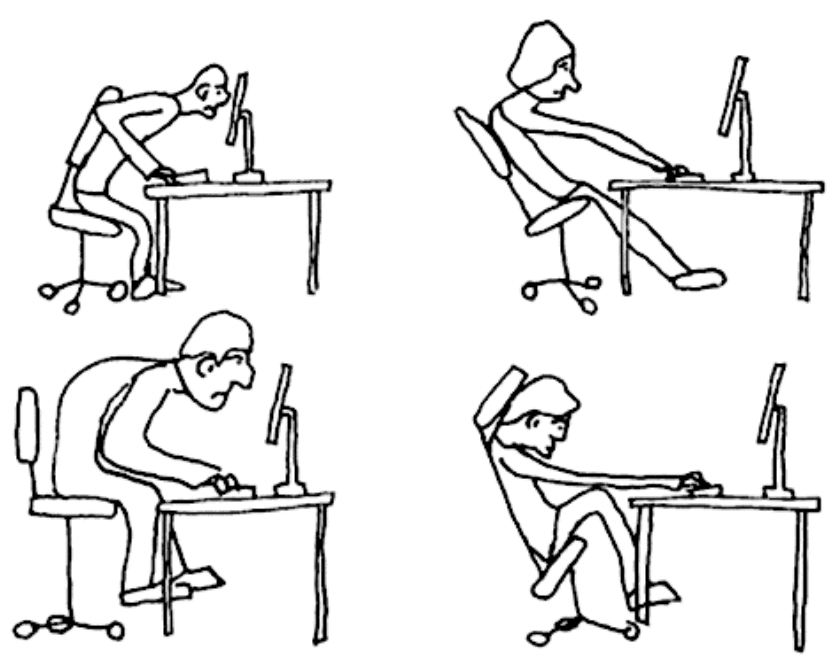
Your furniture shapes your posture!
Posture is how we hold our body while standing, sitting, during work or any other activity. Even during sleep, your body posture matters.
Feet flat. Elbows at ninety degrees. Monitor at eye level.
You hold it for twenty minutes. Then you slide.
By 3 p.m. you're half off the chair and wondering why your back hurts — even though you "sat correctly" all day.
The myth of the perfect sitting position
Think about the last time you sat down to work.You probably adjusted your laptop, grabbed a coffee, opened twenty browser tabs, and got started. (Ok, maybe not twenty but at least one!) But did you notice how you were sitting?? Probably for a while.. But then you entered the “WORK ZONE” and then only work mattered but Posture? Who cares!..
No single position is safe to hold for eight hours. Your spine and hips are built for movement. Research on office workers shows that frequent position changes reduce discomfort more than one perfectly adjusted pose held all day.
Most of us don't think about posture until our body sends us a strongly worded complaint in the form of an aching neck, a stiff back, sore shoulders, or that mysterious headache that appears every afternoon
I swear I have seen the real party parrots (the slack emoji if you know what I mean -> 🦜) in my office, but they were dancing with neck pain!
The funny thing is, posture isn't just about 'sitting up straight'. It's the foundation of how your body works every single day.
And surprisingly, your chair, desk, mattress, and even your pillow are part of the story.
What Exactly Is Posture?
Posture is simply the way your body holds itself while you're standing, sitting, walking, or sleeping.
Think of your skeleton as the frame of a building. When everything lines up properly, the structure stays strong with very little effort. When it's crooked, every beam has to work harder.
Good posture doesn't mean sitting like a soldier.
It means your bones, muscles, and joints are naturally aligned so your body doesn't have to work overtime just to keep you upright.
There are actually two kinds:
- Dynamic posture: how your body stays aligned while you're moving.
- Static posture: how you position yourself when you're sitting, standing still, or lying down.
Your Furniture Is Either Helping You... Or Fighting You!
This is something people often overlook. Even if you're trying to maintain good posture, poor furniture makes it incredibly difficult.
Imagine, what will happen if you are trying to write neatly with a pen that's constantly slipping? Eventually, you'll give up, right?
Your body feels the same way!
- Your Chair: A good chair should support the natural curve of your spine and your feet should comfortably rest flat on the floor. Your knees should be roughly at a 90-degree angle.
- Your Desk: If your desk is too high, your shoulders creep upward. Too low, and you're constantly bending forward.Ideally:
- - Your elbows stay around 90°
- - Your forearms rest comfortably
- - Your shoulders remain relaxed
- - Your wrists stay neutral
- Your Monitor: If your screen sits too low, your neck spends the day looking downward. That's a lot of weight for your neck to support.The top of your monitor should be roughly at eye level so your head stays in a neutral position. Trust me Your neck will thank you
- Your Mattress: Posture does not stop when work ends. You spend roughly one-third of your life sleeping. A mattress that is too soft may allow your spine to sag. One that is too firm might create pressure points. The goal is not the most expensive mattress. It is one that keeps your spine supported in a natural position throughout the night. And your pillow? It has a single very important job: Keep your neck aligned with the rest of your spine. Too high? = Your neck bends upward all night. Too flat? = It bends downward. Neither is ideal!
Small Habits Beat Perfect Posture
Here's some good news for you! You don't need perfect posture every second of the day.
In fact, the best posture is often the next posture. Our bodies are designed to move. Even perfect sitting becomes unhealthy if you stay there for hours.
Instead, build simple habits:
- Sit back in your chair instead of perching on the edge.
- Keep your monitor at eye level.
- Relax your shoulders.
- Keep both feet on the floor.
- Strengthen your core muscles.
- Walk regularly.
- Stretch every hour.
- Avoid looking down at your phone for long periods.
- Use furniture that supports your body instead of forcing awkward positions.
- Set reminders to check your posture throughout the day.
Conclusion
Tiny adjustments, repeated consistently, create lasting change.
Posture is a habit, not a one-time correction. Habits form through repetition tied to cues — not willpower in hour-long blocks.