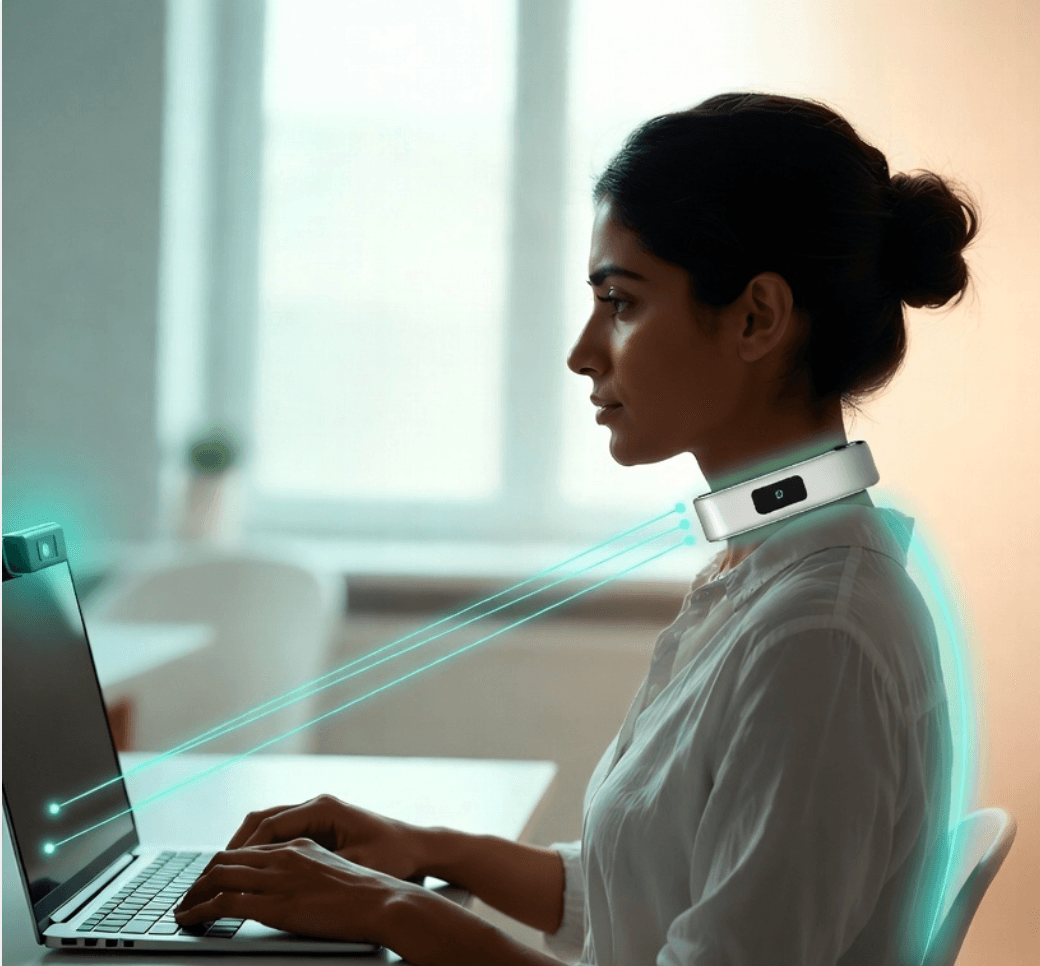
Wearables & AI Posture Coaches: Smart Devices, Webcams, and Apps Detecting Slouching in Real Time
Smart devices, webcams, and apps are detecting slouching in real time. Here is how they work and what they can do for you.
Poor posture has become a silent epidemic in our screen-dominated world.
Hours hunched over laptops and phones contribute to “tech neck,” rounded shoulders, and chronic back pain.
Fortunately, technology now offers real-time solutions: wearable sensors that vibrate when you slouch and AI-powered camera apps that analyze your posture live using computer vision.
These tools go beyond passive braces. They provide biofeedback — immediate alerts that train awareness and encourage correction before pain sets in.
The Scale of the Problem
Low back pain (LBP) is the leading cause of disability worldwide. In 2020, it affected 619 million people globally. Projections show this rising to 843 million by 2050, driven by aging populations and sedentary lifestyles.
Source: WHO — Low back pain
Among working-age adults, cases reached 452.8 million in 2021 — a 52.7% increase since 1990
How posture loads your lumbar discs
Pressure on Lumbar Discs Based on Body Position
How head angle changes the load
Your neck was not designed to hold that load for eight hours. Bring the screen to your eyes, not your eyes to the screen.
| Head position | Effective load on neck |
|---|---|
| Neutral (ears over shoulders) | ~10–12 lbs |
| 15° forward | ~27 lbs |
| 30° forward | ~40 lbs |
| 45° forward | ~49 lbs |
Why screens make it worse
Screens hold your attention, not your posture. Lean in to read fine text and your chin juts forward before you notice.
Video calls add another layer — camera above the screen or preview tile below, neither encourages neutral alignment.
- Raise monitor so top third is at or below eye level.
- Laptop stand + external keyboard for sessions over an hour.
- Webcam at eye level so you sit taller on calls.
Persistent pain deserves a clinician's opinion. For most desk workers, tech neck is a habit and ergonomics problem first — which means it is fixable.
Disc pressure skyrockets with poor sitting posture (up to 220–275% of standing pressure when leaning forward or slouching). This mechanical stress accelerates disc degeneration, muscle imbalances, and pain.
Forward head posture (FHP) — common in desk workers — shifts the head forward, increasing load on the cervical spine and contributing to headaches, neck pain, and reduced lung capacity.
Forward head posture strains neck muscles and alters spinal alignment (illustration shows ideal vs. FHP).
How Wearable Posture Trainers Work
Modern wearables use inertial measurement units (IMUs) — tiny accelerometers and gyroscopes — placed on the upper back or neck.
Users calibrate a “good posture” baseline. When the device detects deviation (e.g., thoracic kyphosis or forward head lean), it delivers gentle vibration (haptic)feedback.
Many sync with smartphone apps for progress tracking, daily goals, and training programs.
Leading Example: UPRIGHT GO 2
- Small, discreet pod (sticks via reusable adhesive or worn with a necklace/strap).
- Dual sensors + gyroscope for precise detection during sitting, standing, or light activity.
- Real-time vibration alerts + app with posture scores, history, and guided training.
- Battery life: several days of typical use.
- Clinically validated (company cites multiple studies showing pain reduction and improved sitting comfort — e.g., 46% improvement in one metric).
Other notable wearables include:
- Halipax Dual Sensor models.
- Sensor-integrated posture bras/vests (e.g., Forme Power Bra).
- Legacy devices like Lumo Lift (pioneered app-connected feedback).
Evidence on Effectiveness
A 2025 systematic review of 8 studies (RCTs and quasi-experimental) found wearable biofeedback devices produce immediate improvements in postural alignment (reduced cervical flexion and thoracic kyphosis angles), body awareness, and self-reported pain (often ~2 points on VAS scales).
Muscle activity during risky postures decreased, and functional stability improved. Vibratory and visual feedback performed best.
Source: Mdpi
Limitations
Most studies are short-term (minutes to a few months), small sample sizes, and heterogeneous devices/protocols. Long-term habit formation and clinical outcomes need more robust RCTs. They work best as complements to physiotherapy and ergonomics, not standalone cures.
AI Webcam & App-Based Posture Coaches
No extra hardware required.
These solutions use your phone or laptop webcam + on-device machine learning (MediaPipe, OpenPose derivatives, custom models) to detect body landmarks in real time — ears, shoulders, head position, torso angle.
When thresholds are exceeded, the app delivers voice prompts, sounds, pop-ups, or gentle notifications. Many run 100% on-device for privacy (no video uploaded to cloud).
- Accuracy & Strengths: Validated systems achieve clinical-grade performance for static and specific dynamic tasks (often >90% accuracy in controlled studies for posture classification). On-device processing enables low-latency feedback. Excellent for desk workers who already sit in front of a camera.
- Challenges: Requires good lighting and camera angle; clothing or hair can occlude landmarks; less effective during highly dynamic movement or when away from the device. User calibration improves results. Privacy-conscious users prefer on-device models.
Market Outlook & Future Trends
The global posture correction market was valued around USD 1.24–1.66 billion recently and is projected to reach USD 1.99–3.3 billion by 2030–2035, growing at CAGR 5.7–8.4%.
Key drivers:
- Rising back/spinal disorder prevalence.
- Sedentary work culture.
- Aging populations.
- Tech integration (sensors + AI + apps).
- Growing consumer wellness focus and workplace ergonomics initiatives.
Source: Grandview Research — Posture correction market report
North America currently leads; Asia-Pacific and Europe show fastest growth.
Future directions:
- More sophisticated multi-modal AI (combining wearables + cameras + other sensors).
- Predictive alerts (detecting fatigue before slouch worsens).
- Deeper integration with Apple Health, Google Fit, or enterprise wellness platforms.
- AR overlays or smarter haptic patterns.
- Stronger clinical validation and potential insurance/employer reimbursement.
Bottom Line & Practical Advice
Wearables and AI posture coaches are effective awareness tools that deliver real-time biofeedback proven to improve alignment and reduce discomfort in the short term. They excel at interrupting the slouch cycle that leads to pain.
However, they are not magic fixes. Sustainable improvement requires:
- Consistent use + behavioral change.
- Ergonomic workstation setup (screen height, chair, desk).
- Strengthening exercises for deep neck flexors, upper back, and core.
- Professional guidance (PT/chiropractor) for existing pain or significant postural deviations
Conclusion
Wearables and AI posture coaches are effective awareness tools that deliver real-time biofeedback proven to improve alignment and reduce discomfort in the short term. They excel at interrupting the slouch cycle that leads to pain.
However, they are not magic fixes.