
Vitamin D Deficiency: A Modifiable Factor in Back Pain, Neck Pain, and Posture Problems
Chronic back and neck pain rank among the leading causes of disability worldwide, affecting hundreds of millions and driving enormous healthcare costs. At the same time, vitamin D deficiency remains a global public health issue
Chronic back and neck pain rank among the leading causes of disability worldwide, affecting hundreds of millions and driving enormous healthcare costs. At the same time, vitamin D deficiency remains a global public health issue, with recent large-scale analyses showing that nearly half the world’s population has insufficient or deficient levels. Emerging evidence links the two — not as a simple cause-and-effect, but as a biologically plausible and clinically relevant association, particularly in cases of severe deficiency or widespread pain.
This article examines the real data: global prevalence figures, observational associations with odds ratios, mechanisms involving muscle and bone, posture-specific impacts, and the mixed but informative results from supplementation trials.
Global Scale of Vitamin D Deficiency
Recent large-scale analyses show that nearly half the world’s population has insufficient or deficient levels.
The prevalence of vitamin D deficiency is highest in populations with lower socioeconomic status, including those in developing countries.
Using serum 25-hydroxyvitamin D [25(OH)D] measurements:
Global Prevalence of Vitamin D Status (Cui et al., 2023 Meta-Analysis; 308 studies, 7.9 million people)
Figure 1: Global Prevalence of Vitamin D Status (Cui et al., 2023). Severe deficiency (<30 nmol/L or ~12 ng/mL) affects about 1 in 6 people; nearly half the global population falls below the common deficiency threshold of 50 nmol/L (~20 ng/mL). Prevalence is higher in winter/spring, at higher latitudes, in the Eastern Mediterranean region, among females, and in lower-middle-income countries. Even sunny climates show high rates due to lifestyle, clothing, skin pigmentation, and indoor work.
Biological Mechanisms: How Low Vitamin D Affects the Spine and Posture
Vitamin D receptors are present in skeletal muscle, bone, and immune cells. Deficiency disrupts several systems that protect the spine:
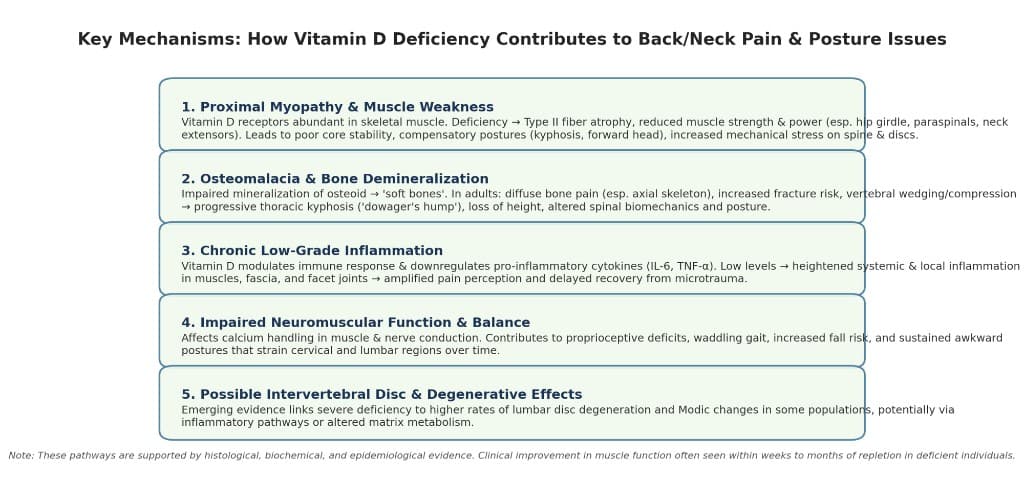
Figure 2: Key Mechanisms Linking Vitamin D Deficiency to Back/Neck Pain and Posture Issues. These pathways are supported by muscle histology, biochemical studies, case reports of osteomalacia-induced kyphosis, and epidemiological associations. Clinical muscle function often improves within weeks to months of correcting severe deficiency.
Evidence Linking Deficiency to Back Pain and Widespread Pain
Vitamin D deficiency can affect your posture in several ways.
Observational studies consistently show higher rates of low vitamin D in people with chronic low back pain (LBP) and stronger associations with widespread or severe pain.
Prevalence of Musculoskeletal Pain by Vitamin D Status (Strong Association Observed in Young Adults)
Figure 3: Prevalence of Musculoskeletal Pain by Vitamin D Status. Data from a young adult cohort showing a strong, statistically significant association.
In postmenopausal women with LBP and lumbar degenerative disease, 74.6% had levels between 10–30 ng/mL and 12.9% had severe deficiency (≤10 ng/mL). Severe deficiency was the strongest predictor of moderate-to-severe pain (OR 5.79, 95% CI 1.57–21.38), outperforming osteoporosis and smoking in that model. Deficiency/insufficiency overall also predicted pain (OR 3.03).
A 2024 cross-sectional analysis (large UK cohort) found that after full adjustment for confounders, severe vitamin D deficiency remained significantly associated with chronic widespread pain (OR 1.26, 95% CI 1.07–1.49), while associations with regional back or neck/shoulder pain attenuated. Earlier meta-analyses of observational data reported OR ~1.5 for chronic widespread pain with deficiency.
Important caveats: Most data are observational — reverse causation (pain limiting outdoor activity → lower vitamin D) and confounding (obesity, older age, sedentary lifestyle, diet) are possible. Not every study finds a link after adjustment, and results vary by population and pain type (stronger for widespread/severe vs localized regional pain).
Neck Pain and Posture: The Postural Chain
Specific high-quality data on isolated neck pain and vitamin D are more limited than for low back pain. Regional neck/shoulder pain associations often weaken after confounder adjustment. However, the postural and muscular mechanisms provide a logical bridge:
- Thoracic kyphosis or lumbar weakness from osteomalacia/myopathy can drive compensatory forward head posture and cervical strain.
- Weak deep neck flexors and extensors (from myopathy) reduce cervical stability.
- Paleopathological evidence from skeletal remains shows vitamin D deficiency markers associated with higher rates of kyphosis, lordosis, and scoliosis, independent of some occupational stressors.
Severe prolonged deficiency can produce irreversible bony deformities if untreated during growth or in extreme adult cases, but most posture effects in modern mild-moderate deficiency are functional and potentially reversible with repletion plus targeted exercise.
What Do Supplementation Trials Show?
Randomized controlled trials (RCTs) and meta-analyses present a more nuanced picture than observational data:
- Some earlier reviews and smaller trials suggested vitamin D reduces pain scores in chronic pain conditions overall.
- More recent, focused meta-analyses on chronic low back pain (including 2024 updates) often find no statistically significant reduction in pain intensity versus placebo across broad populations. One 2024 meta-analysis of 10 RCTs reported SMD -0.13 (95% CI -0.26 to 0.00) for pain scores — borderline and not clinically large. Long-term supplementation and active forms showed similar null results.
- Subgroup signals exist: In overweight/obese adults with marked baseline deficiency (<30 nmol/L), one RCT showed significantly greater improvement in back pain disability scores with supplementation versus placebo after covariate adjustment.
- Combined vitamin D + physiotherapy outperformed physiotherapy alone in one musculoskeletal pain trial for pain severity and interference.
- Large population trials (e.g., monthly high-dose in older adults) showed negligible effects on bodily pain overall, consistent with many participants not being severely deficient at baseline.
Bottom line on supplementation: Treating documented severe deficiency is medically indicated for bone and muscle health regardless of pain. For chronic LBP or neck pain, vitamin D alone is unlikely to be a standalone “cure,” but it may offer adjunctive benefit (especially disability/function) in severely deficient individuals and is low-risk when dosed appropriately. Screening and targeted repletion make more sense than universal supplementation for pain.
Clinical and Practical Implications
- Who to test? Patients with chronic unexplained or refractory back/neck pain, especially those with risk factors (limited sun exposure, obesity, darker skin, older age, indoor occupations, malabsorption, or signs of osteomalacia such as proximal weakness or diffuse bone tenderness). Also consider in progressive kyphosis or poor posture with muscle weakness.
- Testing & targets: Serum 25(OH)D is the standard marker. Many experts aim for >30 ng/mL (75 nmol/L) for musculoskeletal benefits; some aim higher (40–50 ng/mL) in symptomatic patients. Retest after 8–12 weeks of repletion.
- Repletion: Common regimens include 2,000–4,000 IU/day oral vitamin D3 or loading doses (e.g., 50,000 IU weekly for 6–8 weeks) under supervision for severe deficiency, followed by maintenance. Combine with calcium if dietary intake is low, and encourage safe sun exposure + weight-bearing activity.
- Holistic approach: Vitamin D is one piece. Effective management of back/neck pain and posture almost always requires addressing biomechanics (physical therapy, ergonomics, core/neck strengthening), weight management, sleep, and psychosocial factors. In severe osteomalacia cases, dramatic functional gains are possible with repletion.
Conclusion
Vitamin D deficiency is common, biologically linked to muscle weakness, bone softening, inflammation, and postural decompensation, and observationally associated with higher odds of back pain, widespread pain, and (in severe cases) postural deformities such as kyphosis. The strongest signals appear in severe deficiency and widespread pain; associations with isolated regional neck or back pain are more modest after accounting for confounders.
Randomized evidence for supplementation improving pain scores in chronic LBP is limited overall, but targeted correction of severe deficiency remains clinically warranted and may improve function and disability as part of a broader plan. For clinicians and patients dealing with persistent spinal pain or declining posture, checking and optimizing vitamin D status is a low-cost, low-risk intervention with plausible upside — especially when severe deficiency is present.
More high-quality RCTs focused on severely deficient subgroups and combined interventions (vitamin D + exercise) would strengthen the evidence base. In the meantime, the data support treating vitamin D deficiency not merely as a lab abnormality, but as a modifiable contributor to the very real burden of back pain, neck pain, and postural problems.