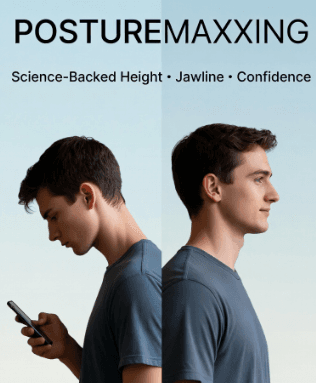
Posturemaxxing: The Science-Backed Way to Instantly Look Taller, Sharper & Pain-Free
Posturemaxxing is the deliberate practice of optimizing posture for both aesthetic and health gains — promising quick wins in height appearance, jawline definition, confidence, and pain relief.
Posturemaxxing is the deliberate practice of optimizing posture for both aesthetic and health gains. Popularized on TikTok and in looksmaxxing communities, it promises quick wins in height appearance, jawline definition, confidence, and pain relief. Unlike fleeting trends, it is grounded in biomechanics, physical therapy research, and psychology.
In 2026, with screen time at record highs, poor posture (forward head posture or "tech neck") affects millions. This article examines the evidence: how correcting posture delivers measurable "instant" visual improvements and lasting pain relief, plus practical steps to do it right.
Good posture instantly makes you appear 1–2 inches taller, improves jawline visibility, reduces a double chin, and boosts perceived confidence and dominance. Health professionals note real benefits (better breathing, less pain, stronger core), but warn that social media often turns it into another aesthetic obsession or overlaps with diet culture. "Good posture" also looks different on different bodies.
In short: Posturemaxxing = fixing your slouch to unlock free gains in height, appearance, face framing, and presence.
Posturemaxxing started as a looks-focused trend: fix your slouch to look taller and get a better jawline. But the real power of good posture goes far beyond aesthetics. It quietly changes how your body functions, how your brain performs, and how other people treat you every single day.
While the surface-level wins (appearing 1–2 inches taller, sharper facial features) are real and motivating, the deeper benefits are what actually make posturemaxxing worth doing long-term.
Posture Changes How People Perceive and Treat You
Your posture is one of the first things people notice, often before you even speak.
Research in social psychology shows that upright posture signals confidence, competence, and higher status. People with good posture are consistently rated as more attractive, more trustworthy, and more likely to be seen as leaders. Slouched posture, on the other hand, makes others unconsciously perceive you as less capable or lower status.
This isn’t just theory. In professional settings, people with better posture are more likely to be taken seriously in meetings, get promoted faster, and even negotiate better outcomes. In dating and social situations, posture affects first impressions more than most people realize. A tall, open posture makes you appear more dominant and approachable at the same time — a rare combination.
Bad posture doesn’t just make you look smaller. It makes you seem smaller in other people’s minds.
Height Gains (Real, Measurable, and Often Immediate)
Poor posture compresses the spine and exaggerates natural curves (kyphosis in the upper back, forward head). Correcting alignment "unlocks" lost height by decompressing vertebrae and restoring neutral spinal curves.
A 2024 study published in PMC found that acute postural exercises increased stature by 0.9–6.0 cm in upright position and up to 7.2 cm supine. Many people regain 2–5 cm (roughly 0.8–2 inches) within weeks of consistent correction. Fitness creators and posture specialists routinely report 1.5–3 cm gains in clients after targeted routines.
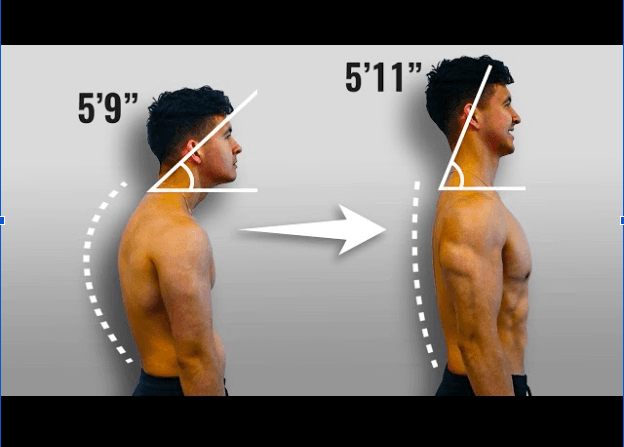
Image ref: The PERFECT 5 Minute Posture Routine To Increase Your Height
Visual proof: In before-and-after demonstrations, slouched posture at 5'9" becomes a visibly taller, more upright 5'11" stance simply by stacking ears over shoulders and restoring lumbar curve.
This is not "growing taller" in the skeletal sense — it is revealing your true structural height by eliminating compensatory slouching. For desk workers and phone users, the average loss from chronic forward head posture can reach 1–2 inches over time.
The Hidden Health Costs of Poor Posture (Beyond Pain)
Most people only think about back and neck pain when they hear “bad posture.” The reality is more serious.
Forward head posture and chronic slouching compress your rib cage and diaphragm. This reduces lung capacity and leads to shallower breathing. Over time, this can affect oxygen intake, increase fatigue, and even influence mood and anxiety levels.
Poor posture also disrupts digestion. When you’re constantly hunched, your organs get compressed, which can slow digestion and contribute to issues like acid reflux and bloating.
Sleep quality often suffers too. People with rounded shoulders and forward head posture tend to have more tension in their neck and upper back, making it harder to fully relax at night. Many chronic “insomnia” cases actually have a postural component.
The most underrated effect? Mental health. Multiple studies link poor posture with higher rates of depression and lower self-esteem. The body and mind are deeply connected — when your body is stuck in a defensive, collapsed position, your brain tends to follow
Posture as a Status and Attraction Signal in 2026
In the age of dating apps, video calls, and social media, posture has become more important than ever.
On video calls and photos, good posture makes a massive difference in how attractive and competent you appear. Many people spend hours editing photos or choosing good angles, when simply standing or sitting taller would have a bigger impact.
In real life, posture acts as a silent status signal. In group settings, the person with the best posture often naturally commands more attention. This is especially noticeable in dating and social dynamics. Good posture makes you look more masculine or feminine (depending on your goals), more confident, and more “high value” without saying a word.
This is why posturemaxxing has gained traction beyond just looksmaxxing communities — it delivers compounding social returns.
Jawline Definition and Facial Aesthetics
Forward head posture (FHP) does more than strain the neck — it directly alters facial appearance.
When the head juts forward, the mandible (lower jaw) is pulled into a retracted or downward position. This creates skin folds under the chin (double chin appearance even in lean individuals), reduced jaw projection and definition, and increased tension in mastication muscles and potential TMJ strain.
Research on orofacial effects shows slumped or forward head postures reduce maximal mouth opening and shift jaw movement trajectories posteriorly. Correcting to neutral head posture improves condylar rotation and mandibular positioning, supporting a sharper, more defined jawline and better facial symmetry.
Tech neck specifically folds skin under the chin, creating a "double chin" effect that disappears or dramatically improves with restored alignment.

Before/after posture transformation: standing noticeably taller with shoulders back and head neutral instantly changes perceived facial structure and overall presence.
Image ref: How to Improve Posture In 30 Days, According to Experts
Confidence and Psychological Boost
Upright, expansive posture influences self-perception through embodied cognition. Multiple studies show that adopting open, tall postures increases feelings of power, confidence, and self-esteem while reducing helplessness.
Power-posing research (despite early hormonal claims being debated) consistently demonstrates psychological benefits: participants in upright postures report higher self-worth, better mood, and greater confidence in self-evaluations. Slouched postures amplify negative self-talk and lower state self-esteem.
In short: Standing tall doesn't just look confident — it feels more confident within minutes.
The Health Payoff: Relieving Back Pain and Neck Pain
Poor posture is not just cosmetic — it is a major driver of musculoskeletal pain.
The Scale of the Problem (2025–2026 Data)
"Tech neck" from forward head posture places enormous stress on cervical structures. Every inch the head moves forward adds roughly 10 pounds of effective weight on the neck.
- Lifetime prevalence of neck pain: 60–80%
- Office workers: Up to 70% experience neck pain
- College students (one 2026 study): 64.5% reported neck pain linked to prolonged social media/device use
- Global neck pain burden has risen sharply; projections show continued increases through 2044
The Future of Posturemaxxing
We are entering a new phase where technology is making posture improvement much easier.
AI-powered posture tracking apps, wearable sensors, and smart clothing are becoming more accurate and less annoying. Instead of guessing whether you’re slouching, people can now get real-time feedback throughout the day.
This shift is important because awareness alone is not enough for most people. The combination of better education + smart tools is what will move posturemaxxing from a niche trend into mainstream health behavior.
Evidence That Posture Correction Works for Pain
For low back pain, restoring neutral lumbar curve and reducing anterior pelvic tilt decreases load on discs and facet joints. Many patients report meaningful relief within days to weeks of consistent postural awareness + targeted strengthening.
Key mechanism: Proper sitting/standing posture distributes load evenly, reduces compensatory muscle tension (upper traps, levator scapulae, hip flexors), improves breathing/diaphragm function, and decreases inflammation from chronic overload.
- Global Postural Re-education (GPR): A 2025 systematic review and meta-analysis showed significant reductions in neck pain (SMD −0.41) and disability (SMD −0.73) compared to other exercise programs.
- Exercise interventions (including posture-focused work): Moderate-certainty evidence that they reduce the risk of new neck pain episodes by about 51% (OR 0.49) in the short term.
- Specific posture-correction programs for forward head posture and mechanical neck pain show improvements in pain, range of motion, and craniocervical alignment.
How to Posturemaxx Effectively (Evidence-Based Protocol)
Daily foundations:
- Awareness resets — Every 30–45 minutes: Ears over shoulders, shoulders over hips, chin slightly tucked (gentle "double chin" cue).
- Ergonomics — Screen at eye level, lumbar support, feet flat. Use a standing desk converter if possible.
- Breathing — Belly breathing (diaphragmatic) instead of shallow chest breathing.
Targeted Exercises (10–15 min/day)
Progression: Weeks 1–2 focus on awareness + mobility. Weeks 3–6 add strengthening + endurance. Ongoing: integrate into daily movement (walking with tall posture, "posture walking").
- Chin tucks (isometric + dynamic)
- Wall angels or Y/T/A raises
- Thoracic extensions (foam roller or chair)
- Dead bugs + glute bridges (core + posterior chain)
- Upper trap/pec stretches + deep neck flexor strengthening
Tools That Help
- Posture reminder apps and wearables (vibration or app-based nudges)
- Temporary posture correctors (use sparingly — they are training wheels, not solutions)
- Professional input: Physical therapist or posture specialist for personalized assessment
Common Mistakes to Avoid
- Over-correcting into military rigidity (creates new tension)
- Relying only on braces without strengthening
- Ignoring lower body (tight hip flexors and weak glutes sabotage upper posture)
The Trend vs. Sustainable Reality
Posturemaxxing went viral because the visual changes can appear quickly. However, lasting results require consistency. Social media sometimes frames it as another aesthetic hack or overlaps with slimming/diet culture pressures. Experts emphasize that "good posture" looks different on different bodies and that sustainable improvement comes from strength, mobility, and awareness — not perfection or gadgets alone.
The best outcomes combine short-term aesthetic motivation with long-term health habits.
Conclusion: Posturemaxxing Is Worth It
The data is clear: Improving posture delivers immediate visual upgrades (height appearance, jawline definition, confident presence) and clinically meaningful reductions in neck and back pain. Whether you are chasing the aesthetic edge of posturemaxxing or simply want to stop waking up with a stiff neck, the science supports starting today.
Your future taller, sharper, pain-free self will thank you.
The people who treat posturemaxxing seriously don’t just end up looking taller and more confident. They breathe better, feel better, sleep better, and are treated differently by others
- Do 10 chin tucks + 30 seconds wall angels right now.
- Set a phone reminder every hour: "Posture check — ears over shoulders."
- Track how you feel and look after 7–14 days.