Mobility and Strength Training for Posture: What Actually Helps Muscle Health
Stretching eases stiffness. Strength training is what the evidence links more clearly to resting alignment. Here is how both support muscle and posture health — and how PostureWise helps you use that capacity at your desk.
Most desk days ask the same muscles to hold still for hours, then wonder why the neck feels heavy at 4 p.m.
Posture is not a pose you remember. It is a skill your muscles keep running in the background. When some tissues get short and guarded, and others get underused, the body finds a cheaper shape: chin forward, shoulders rounded, low back hanging on ligaments instead of muscle.
The usual advice is to stretch more, or to sit up straighter. The research is more specific. Mobility work can restore range of motion and ease discomfort. Strength training is what has the clearer effect on measured resting alignment, especially in the neck and upper back. Combined programs are what most physiotherapy trials actually use.
This piece stays with that evidence. It covers what mobility and strength each do for muscle and posture health, where the data is strong, where it is mixed, a practical routine for desk workers, and how PostureWise fits as the in-the-moment layer — so the capacity you train on purpose still shows up during the hours you sit.
Why muscles, not willpower, hold your posture
Your skeleton is the frame. Muscle, tendon, and fascia are the cables that keep the frame stacked with little conscious effort. When those cables are strong and able to lengthen, sitting and standing cost less. When they are stiff in some places and weak in others, the body leans on a slouch because a slouch is metabolically cheap.
Desk work loads that system in a predictable way. Hip flexors and pecs spend the day shortened. Deep neck flexors, mid-back retractors, and glutes spend the day under-recruited. Over months, that is a common setup for forward head posture, rounded shoulders, and a tired lumbar spine.
World Health Organization data puts the stakes in context. About 1.71 billion people live with musculoskeletal conditions. Low back pain alone affected 619 million people in 2020 and is the leading cause of disability worldwide. WHO’s self-care guidance for non-specific low back pain includes being physically active, and its treatment list includes physical therapies that improve muscle strength and the ability to move.
Source: WHO — Low back pain
That is the health case for training the tissues that hold you up. It is also why “sit up straight” fails as a plan. Cueing a shape you cannot hold is like asking a tired muscle to stay contracted for eight hours. Capacity has to come first. Awareness has to follow, or the old shape returns as soon as attention moves to the next tab.
Source: WHO — Musculoskeletal health
What mobility work actually does
Mobility is the usable range of a joint — how far you can move with control. Stretching is one tool inside that. Thoracic extension over a chair, a doorway pec stretch, a hip-flexor lunge, and gentle neck side-bending are mobility drills. They are useful when a joint no longer has the room to stack in a neutral position.
If the chest and the front of the hips cannot lengthen, the upper back and pelvis have fewer options. The head then drifts forward to keep the eyes on the screen. Mobility work can open those options. It can also reduce the guarded, “stuck” feeling that makes people fidget and then collapse again.

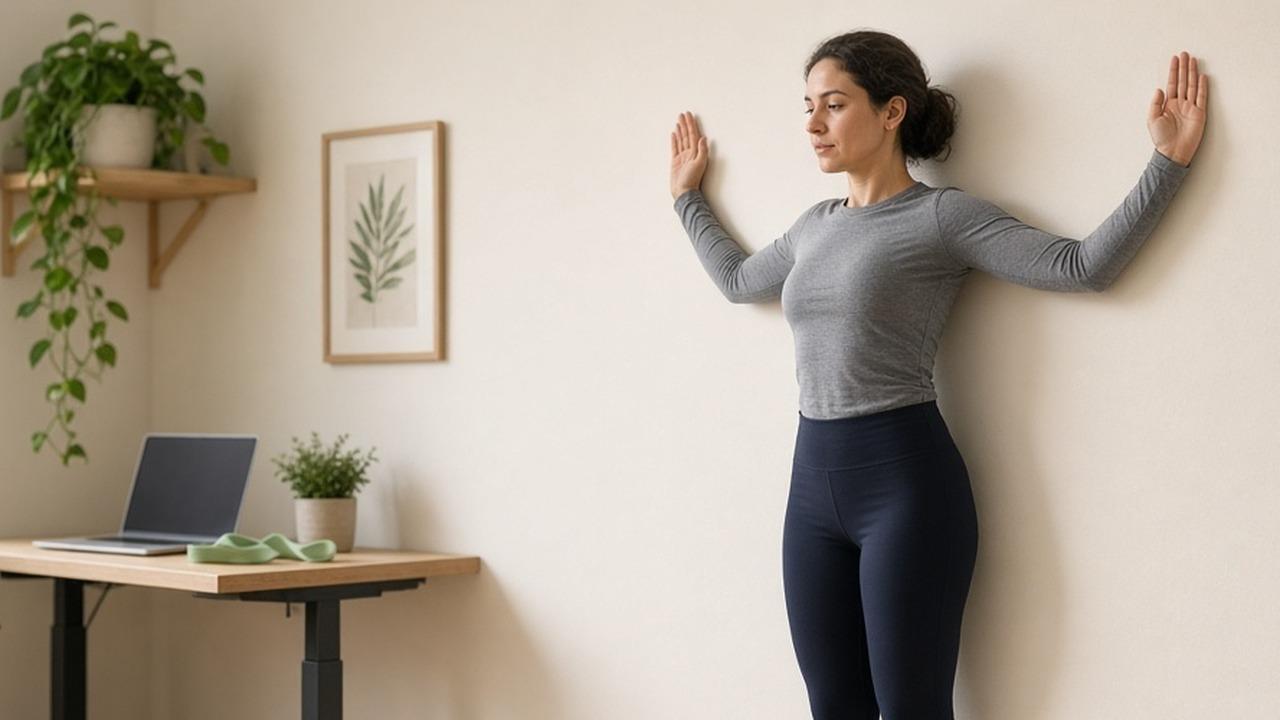
A doorway pec stretch restores room through the front of the shoulder. Range of motion is the job. Holding the new range at a desk is a strength and awareness job.
What mobility work is weaker at, on its own, is changing the posture you rest in. A 2024 systematic review with meta-analysis of 23 studies (969 participants) found that neither a single stretching session nor weeks of stretching produced a statistically significant change in spinal or lumbopelvic posture. The authors concluded, with moderate-certainty evidence, that stretching is not supported as a standalone treatment of muscle imbalance.
Source: Warneke et al., 2024 — Sports Medicine - Open (PubMed)
That finding is easy to misread as “stretching is useless.” It is not. Stretching still has a role in comfort and range of motion. A randomized trial of 142 office workers with neck, shoulder, and lower-back pain found that a daily stretching program reduced pain scores versus a no-treatment control (neck mean difference −10.55 on the Cornell questionnaire, 95% CI −14.36 to −6.74; lower back −7.8, 95% CI −11.08 to −4.53). The stretching group was also the only arm that kept improving between months four and six.
Read both results together: mobility work can help people feel better and move more freely. It is a weak lever, by itself, for changing the angles a researcher measures when you sit still. For alignment, you need tissues that can produce force.
Source: Shariat et al., 2018 — Brazilian Journal of Physical Therapy
What strength training does for muscle and posture health
Strength training asks a muscle to produce force against resistance — bodyweight, a band, a dumbbell, or a machine. For posture, the relevant tissues are the ones that fight the desk shape: deep neck flexors, mid and lower trapezius, serratus anterior, thoracic extensors, the deep trunk, glutes, and the rest of the posterior chain.
WHO’s adult physical-activity guideline already includes this for general health: muscle-strengthening work at moderate or greater intensity, covering all major muscle groups, on two or more days a week, on top of 150–300 minutes of moderate aerobic activity. Thirty-one percent of adults worldwide do not meet the aerobic recommendation. Strength work is the piece desk workers skip even more often.
On posture specifically, the same 2024 meta-analysis found that chronic strengthening was associated with large improvements in measured alignment (Cohen’s d = −0.83, p = 0.01). Strengthening outperformed stretching (d = 0.81, p = 0.004). The effect was concentrated in the thoracic and cervical spine (d = −1.04, p = 0.005). The lumbar and lumbopelvic region did not show a significant effect (d = −0.23, p = 0.25).
That regional split matters. Upper-back and neck alignment have a clearer strengthening signal in this literature. Lower-back curve is influenced by many things besides local muscle size — hip mobility, disc loading, pain, and how long you sit without changing position. Strength still supports lumbar health. It is not a guaranteed reshape of every spinal curve.
Source: WHO guidelines on physical activity and sedentary behaviour (2020)
| Intervention | Effect on posture (Cohen’s d) | Statistically significant? |
|---|---|---|
| One stretching session | 0.01 | No (p = 0.97) |
| Weeks of stretching | −0.19 | No (p = 0.16) |
| Weeks of strengthening | −0.83 (large) | Yes (p = 0.01) |
| Strengthening vs stretching | 0.81, favoring strength | Yes (p = 0.004) |
Table: Cohen’s d values from Warneke et al. (2024), 23 studies and 969 people. Negative signs in the original paper indicate reduced postural deviation. Stretching did not reach statistical significance. Strengthening did, and it beat stretching in head-to-head comparison.
Source: Warneke et al., 2024 — Sports Medicine - Open (PubMed)
Why clinics combine both
Physical therapists restore range where tissue is short, then load the muscles that should own the new range. That combined model is what most forward-head and “upper crossed” trials actually test.
A 2024 systematic review and meta-analysis in BMC Musculoskeletal Disorders found that therapeutic exercise improved forward head posture, rounded shoulders, and thoracic kyphosis in people with upper crossed syndrome. The authors noted that comprehensive programs — strengthening, stretching, and shoulder-focused work together — were a sensible clinical approach.
A 2023 review of hyperkyphosis (an exaggerated upper-back curve) found a similar pattern. Programs that stretched the front of the trunk and strengthened the back reduced kyphosis by about 7 degrees versus comparison groups (mean difference −6.97, 95% CI −9.84 to −4.10). Evidence for stretching alone was low quality.
The honest caveat sits next to those gains. Alignment can change while pain and day-to-day function lag. A 2026 meta-analysis of 28 randomized trials (901 people) reported large improvements in forward-head, rounded-shoulder, and thoracic angles, with high statistical heterogeneity. Effects on pain, function, balance, and muscle activation were inconclusive. Better angles are a real outcome. They are not a promise that every ache disappears.
Source: Sepehri et al., 2024 — BMC Musculoskeletal Disorders
The hyperkyphosis number above is from a 2023 systematic review of stretching plus strengthening in adults. Stretching as a standalone treatment had low-quality support in that review.
Source: 2023 review — stretching and strengthening for adult hyperkyphosis (PubMed)
The 2026 alignment-versus-pain caveat is from a systematic review of 28 randomized trials in people with upper crossed syndrome: large posture effects, mixed clinical effects, and high heterogeneity across studies.
Source: 2026 meta-analysis — corrective exercise for upper crossed syndrome
What each tool is for
If you only remember one distinction, remember this one.
| Job | Mobility / stretching | Strength training |
|---|---|---|
| Range of motion and stiffness | Primary tool | Helps over time as tissue adapts |
| Resting neck and upper-back alignment | Weak as a standalone | Stronger evidence in meta-analysis |
| Capacity to hold a better shape | Limited | Primary tool |
| Desk-related discomfort | Some office-worker RCT support | Part of broader exercise therapy |
| WHO adult health guideline | Not the headline recommendation | 2+ days/week, major muscle groups |
A practical routine for desk workers
You do not need a 90-minute gym block. You need enough load, often enough, on the muscles that fail first at a laptop — plus enough mobility that those muscles have room to work. Persistent or radiating pain, numbness, unexplained weakness, or a recent injury belongs with a clinician before you self-prescribe.
A realistic weekly shape looks like this: two or three 20–30 minute strength sessions, plus two or three minutes of mobility every hour or two at the desk. The strength sessions build the engine. The micro-mobility breaks keep the engine from seizing between meetings.
Mobility you can do between calls (2–4 minutes)
These are range drills, not a posture “reset” that lasts all afternoon. They make the next hour cheaper. They do not replace the strength work.
- Thoracic extension: sit tall, hands behind your head, gently extend over the chair back for 5 slow breaths.
- Doorway or wall pec stretch: forearm on the frame, lean until you feel the front of the chest — 30–45 seconds each side, no forcing.
- Hip-flexor half-kneeling stretch: back knee down, tuck the pelvis under, 30 seconds each side. Tight hips pull the lumbar spine into a slouch or an arch.
- Neck side-bend: ear toward shoulder, opposite hand resting gently, 20–30 seconds each side. Keep the stretch mild.
Strength work that maps to desk posture (2–3 days/week)
Progress by adding a rep, a second of control, or a little resistance — not by chasing a military-stiff chest. Over-correcting into a braced, ribs-flared pose is another kind of fatigue. Neutral is stacked and quiet, not rigid.
- Chin tucks / deep neck flexor holds: slide the head straight back into a gentle double-chin. Hold 5–10 seconds, 8–10 reps. This is the muscle group that loses the fight with forward head posture.
- Rows or band pull-aparts: 2–3 sets of 8–12. Train the mid-back to own scapular position instead of parking in a round-shoulder hang.
- Wall angels or Y/T raises: slow, 2–3 sets of 8–10. If your arms cannot reach the wall without arching the low back, that is useful information — mobility first, then the raise.
- Dead bugs or bird dogs: 2–3 sets of 6–8 slow reps per side. Train the trunk to stay quiet while the limbs move, which is closer to real sitting than a crunch.
- Glute bridges or hip hinges (Romanian deadlift pattern): 2–3 sets of 8–12. The posterior chain is what lets you sit and stand without hanging on the lumbar ligaments.
The missing layer: using the capacity you trained
Here is the gap most exercise plans ignore. You can row, bridge, and stretch three evenings a week and still spend 30 hours in forward head posture, because nobody is watching the 30 hours.
Exercise changes what your body can do. Desk time decides what your body actually does. The research on biofeedback and on movement breaks points the same way: people improve when they notice the slouch close to the moment it happens, not only when they remember a routine at 7 p.m.
That is the job PostureWise is built for. It is a native desktop coach, not a workout app and not a medical device. It watches how you sit on your own camera, on your own machine, and nudges you when the workday shape starts to win.
How PostureWise pairs with mobility and strength
PostureWise names the drift instead of only giving a mystery score. Forward head, rounded shoulders, tilt, screen distance, slouching — those labels map onto the training above. If the app keeps flagging forward head, the deep neck flexors and thoracic extension work are the matching homework. If rounded shoulders dominate the week, pec mobility and rowing work are the matching homework.
The coaching is built to stay out of the way of the work itself. Analysis stays on-device. Alerts start as a quiet tray cue and can escalate to a short popup with a live overlay. You can snooze through a meeting, set quiet hours, and use periodic monitoring so the camera is not on all day. Weekly stats show whether desk habits are actually changing alongside the gym work — which is the only trend that matters.
- Train capacity 2–3 days a week (strength + enough mobility to use it).
- Let PostureWise catch the old pattern during real sitting, with a personal baseline instead of a generic “sit like a soldier” model.
- Use the named issue as the cue for a 30-second reset: chin back, ribs down, feet on the floor — then get back to the task.
- Look at the weekly stats. If strength sessions are consistent but scores are flat, the desk layer is where the leak is.
In other words: mobility restores room, strength restores the engine, PostureWise restores the practice. Drop any one of those and the other two work harder than they should. Keep all three modest and consistent, and the day gets cheaper on your neck without turning posture into a second job.
What this is not
- Not a claim that stretching “fixes” posture. The 2024 posture meta-analysis does not support stretching as a standalone alignment treatment.
- Not a claim that strength training erases pain for everyone. Alignment gains in trials are more consistent than pain and function gains.
- Not a substitute for clinical care. Night pain, trauma, fever, unexplained weight loss, numbness, or pain down an arm or leg needs a professional assessment.
- Not a reason to sit perfectly still. The healthiest sitting pattern is still the next one. Strength makes each position cheaper. Movement still matters.
Conclusion
Muscle health and posture health share the same tissues. Mobility keeps those tissues able to lengthen. Strength training is what the better-quality posture research links to changes in neck and upper-back alignment, and it is already in the WHO playbook for adult health. Combined programs are how clinicians usually put the two together. Pain relief is possible and worth training for; it is also less guaranteed than a change in angle on a photograph.
For people who live at a screen, the last piece is the workday itself. PostureWise will not do your chin tucks. It will notice when your head has drifted, name the issue, and give you a quiet chance to use the strength you already built — without another dashboard to babysit.
Train the muscles. Leave them room to move. Then practice the shape during the hours that actually cause the problem. That is the whole method.